
Phone Scams in Singapore 2025: What’s Changed, What’s New, How to Stay Safe

In the first half of 2025, Singaporeans lost more than S$456 million to scams of all types. Phone calls remain one of the most common entry points.

The reason is simple: the voice on the other end of the line feels real. And now, thanks to advances in artificial intelligence, that voice might even sound like someone you know.


The Old Tricks Still Work

Not all scams are high-tech. Many are the same tricks that have been circulating for years:

  • Fake “police” officers warning you about legal trouble.
  • “Customs” or “courier” agents demanding payment for a held parcel.
  • Bank officers “alerting” you to a suspicious transaction and asking for your details.

Despite endless advisories, people still fall for them. Fear, urgency, and authority bias combine to short-circuit rational thinking. A stern voice claiming to be from the SPF or ICA can make anyone panic.


What’s New in 2025

Where things get worrying is how these scams are evolving.

AI Voice Cloning

Scammers no longer need to stick to broken English. With just a few minutes of recorded audio — scraped from social media, podcasts, or leaked calls — they can now clone voices with startling accuracy.

A parent might hear their child’s exact voice crying for help. A finance staffer might hear the CFO’s familiar tone ordering an urgent transfer. And increasingly, scammers are training AIs on local accents and Singlish inflections, so the voice on the line doesn’t just sound human — it sounds Singaporean.

This is especially dangerous because it feeds directly into government-official impersonation scams, which cost victims about S$126.5 million in the first half of 2025 alone. When the “officer” on the phone speaks in an accent and cadence that feels familiar, the call becomes that much harder to doubt.

Caller ID Deepfakes

Until recently, many scams were easy to spot: overseas calls showed up with the +65 prefix even when the number claimed to be local. For a while, telcos and regulators clamped down, filtering out spoofed “+65” numbers so people could tell at a glance if something looked wrong.

That defence has now largely eroded. Scammers are bypassing those filters. Calls can display as if they are really from DBS, Singtel, or even official SPF hotlines, without the +65 giveaway. Some even inject logos and caller IDs to lend extra legitimacy.

The result? What used to be a clear red flag is gone. What appears on your screen can no longer be trusted.

Hybrid Attacks

We’re also seeing scams that start with a robocall (“Press 1 for assistance”), shift to a live scammer, and then follow up with a WhatsApp message. Each layer adds pressure and realism.


Next Step: Deepfake Video Calls

Voice cloning is only the beginning. The frontier is deepfake video calls.

Scammers are already experimenting with faked Zoom or WhatsApp calls where the “face” looks like your relative, colleague, or boss. And with AI models getting better by the month, early glitches — odd blinking, lip-sync issues, frozen frames — will soon pass the Turing test.

That means spotting technical flaws won’t be enough. Instead, look for behavioural telltales:

  • Is the request unusual (e.g. money, OTPs, urgent transfers)?
  • Is the caller pressuring you to act fast?
  • Are they refusing to let you verify through another channel?

These are the real signs of a scam — not whether the video looks pixel-perfect.


The Psychology of the Call

Why are phone calls so effective when emails and texts get ignored?

Because a call demands your attention right now. You can’t skim, you can’t delay, you can’t quietly Google for clues. Add a stern voice claiming authority or a loved one sounding desperate, and your instinct is to respond immediately.

This is exploiting cognitive biases:

  • Authority bias: obeying perceived figures of power.
  • Urgency effect: reacting before thinking.
  • Familiarity heuristic: trusting voices and accents that sound like “our own”.

How to Protect Yourself

Here’s the good news: you don’t need to be a cybersecurity expert to defend yourself.

  1. Pause First
    • Scammers rely on you reacting instantly. Even a 10-second pause can break their script.
    • Why it works: scammers build panic and urgency, and their scripts are designed for speed. Silence isn’t part of the plan. When you stop to think, the fear fades and you regain control.
  2. Verify via Official Channels
    • If a bank, telco, or government agency calls you, hang up and call back using the official hotline from their website.
    • Don’t trust the displayed number alone.
  3. Don’t Trust Appearances
    • A familiar voice, or even a video call, is not proof.
    • Always double-check through a separate channel.
  4. Filter Unknown Calls
    • Some people set their phones so that only numbers saved in their contacts ring through. Everything else goes to voicemail or silent.
    • Pros: blocks a huge volume of scam calls automatically, reduces distraction.
    • Cons: not practical for business users who need to accept unknown numbers (e.g. clients, deliveries, job calls). You risk missing legitimate calls if you don’t check voicemails.
    • Tip: if you don’t need to be reachable by unknown numbers, this is a strong additional layer of defence.
  5. Use Tools
    • Install ScamShield and use your telco’s call filtering services.
    • Report scam calls so numbers get blocked faster.
  6. Talk About It at Home
    • Educate elderly relatives and children. Role-play scam scenarios so they know what to do.

    If You’ve Been Targeted

    • Disengage quickly — you don’t owe scammers politeness.
    • Report: call the ScamShield Helpline at 1799.
    • Contain the damage: If you gave away information, call your bank immediately, reset your accounts, and file a police report.

    Closing Thoughts

    Scams aren’t going away. They’re upgrading.

    Today, it might be a cloned voice on the line. Tomorrow, it could be a deepfake face on a video call. Either way, the defence is the same: slow down, verify, and never act on impulse.

    Because the moment you feel pressured to “just do it now” — that’s the moment the scammer is winning.

    So talk about scams with your family before scammers do.
    The SAF Bulk-Order Scam: Why It Works, and How to Guard Against It

    Over the past two weeks, Singapore has seen a spate of fake bulk orders — from 150 packets of briyani at Tiong Bahru Market to bakeries and even florists. At first glance, these looked like pranks. But police investigations and charges now confirm that a scam syndicate is behind it, using local “mules” to supply phone lines and bank accounts.


    How the scam works

    1. The setup Scammer calls or messages using a local number obtained from a mule. They pose as SAF personnel or another trusted professional. They place a large order — big enough to stretch resources, small enough to feel believable.
    2. The squeeze Near collection time, they demand extra items the business doesn’t carry. If refused, they threaten to cancel the order, leaving the vendor stuck with wasted stock.
    3. The fake solution To “help,” they offer a contact for a supplier. Desperate not to lose money, the business pays this supplier — who is, of course, part of the same syndicate.
    4. The cash-out The payment flows through mule bank accounts. Goods are never delivered. The original order is never collected. Losses often exceed the supposed value of the bulk order.

    This isn’t entirely new. In 2022, scammers used fake restaurant reservations to push “extra wine and seafood” via fake suppliers. In 2024, they targeted curtain and blinds retailers. The SAF angle in 2025 simply added urgency and credibility.


    Why businesses fall for it

    • Local phone numbers and bank accounts look legitimate.
    • WhatsApp profiles use stolen photos of Singaporeans.
    • Scammers speak with local accents.
    • They pose as trusted professions — soldiers, teachers, healthcare workers.
    • They impose tight deadlines, forcing rushed decisions.
    • And when asked for a deposit, they spin creative excuses, such as:
      • “It’s a surprise/secret party, can’t risk anyone knowing.”
      • “Government department — we can only process payment later.”
      • “The officer handling payment has already left for the day.”
      • “This is below our threshold for issuing a PO.”
      • “We’ll settle payment on collection — can you trust us just this once?”
      • “We already transferred — here’s a screenshot.” (fake or doctored)
      • “My colleague is handling finance, I’ll chase them later.”
      • “We’re regular customers from SAF/school/clinic — we’ll pay once delivered.”

    Each excuse buys them time, lowers suspicion, and pressures the business into preparing without commitment.


    Guarding against the scam

    Here’s what SMEs can do immediately:

    • Set a clear SOP for deposits. Publish a threshold so staff have cover. Example: 30% deposit for orders above $300, 50% for orders above $1,000.
    • Do not start production until the deposit clears. No exceptions.
    • But keep the human factor. Thresholds are a floor, not a ceiling. If an order below $300 feels off — unusual quantities, last-minute demands, or requests to use a “supplier” you’ve never heard of — treat it with equal caution.
    • Verify independently. For large orders, call back on the organisation’s official line or request a purchase order via corporate email. Don’t rely solely on WhatsApp.
    • No third-party payments. Never pay a supplier introduced by the buyer without checking business registration, UEN/GST, and landline verification.
    • Document and escalate. Save chats, numbers and screenshots. Report to SPF via ScamShield (1799 hotline or app). Sharing attempts with other SMEs builds collective defence.

    The mule dimension

    The recent charge of a 22-year-old student shows how syndicates work: they need locals to provide bank accounts, SIM cards, and even Singpass access. These aren’t pranksters; they’re infrastructure providers.

    From October 2025, Singapore will roll out a facility restriction framework: anyone warned, investigated, or convicted for mule offences may be barred from opening bank accounts, registering mobile lines, or using Singpass/Corppass.

    On paper, this makes sense. Cut off the supply of mule infrastructure, and syndicates lose their cover.

    But here’s the paradox: banking, telco and Singpass aren’t luxuries — they’re the basic tools of living here. Restrict them permanently, and you risk creating digital outcasts. With no re-entry path, some may fall further into the same criminal networks we’re trying to dismantle.


    The bigger picture

    Scams in Singapore aren’t going away. In just the first half of 2025, nearly 20,000 cases were reported, with close to half a billion dollars lost. The SAF bulk-order scam may look small compared to investment or romance frauds, but it shines a light on the plumbing that keeps scams alive: mule accounts, local phone lines, and public trust in familiar voices.


    Bottom line

    For SMEs: a published deposit policy plus a healthy dose of common sense is your best defence. For policymakers: restriction without rehabilitation risks breeding repeat offenders. For all of us: real resilience against scams only comes when government, commercial systems, and public education move in sync.

    Crypto: You Can’t Uncook the Rice

    In January 2019, UC Berkeley researcher Nicholas Weaver stood on stage at the Enigma security conference and declared: “Cryptocurrency: Burn it with fire.” Ars Technica covered it, and his message was blunt: crypto wastes electricity, fuels crime, and should be scrapped.

    Full video above, read the Ars Technica article here.

    At the time of his speech, Bitcoin was worth about US $3,500. Today, it trades at around US $116,000 — more than thirty times higher. That doesn’t erase his criticisms, but as the Chinese saying goes: 生米煮成熟饭 — rice has already been cooked. You can’t uncook it. The better question is: what do we actually do with it now?


    Weaver’s “Myths” — and Today’s Reality

    Myth 1: Crypto is good for payments. Weaver argued it’s clumsy and expensive for everyday shopping. He was right. But skip the coffee line — crypto does shine in high-friction transfers. Migrant workers and freelancers now use stablecoins to send money cheaply and instantly across borders.

    Myth 2: Crypto is a currency. Weaver warned that Bitcoin’s deflationary design discourages spending. He was right — it never really worked as everyday money: too slow, volatile, and clunky to buy coffee with. But the market reframed it. Bitcoin became not “internet cash,” but “digital gold.” Instead of spending, people hold it. Scarcity gives it value, regret fuels holding, and ETFs make it easy for ordinary investors. In short, Bitcoin failed as a currency but succeeded as an asset class.

    Myth 3: It’s safe and decentralised. He pointed to hacks, frozen funds, and lost wallets. Still risks, yes. But since 2019, custody has matured: ETFs, regulated exchanges, and hardware wallets mean people don’t always need to guard their keys alone.

    Myth 4: Blockchain will revolutionise everything. He dismissed “blockchain for [insert industry: healthcare, supply chain, real estate, voting]” as hype. And many projects did collapse. But serious pilots remain — banks tokenising bonds, deposits, and funds. Quiet, back-end changes rather than flashy revolutions.


    What People Actually Use Crypto For

    • Protect savings from inflation In Argentina, Turkey, and Nigeria, families use crypto to shield their money from collapsing local currencies.
    • Send money abroad instantly A Filipino worker in Singapore can send digital dollars (stablecoins) home in minutes, saving S$20–30 per transfer.
    • Borrow or earn without a bank Platforms let you borrow against your holdings or stake them to earn interest — a kind of DIY savings account.
    • Buy and resell tickets safely Concert and event tickets can be issued as NFTs, each with a unique ID on the blockchain. That makes them hard to fake, easy to verify, and simple to transfer. Organisers can even cap resale prices or require resale through official channels. Done right, this cuts down on counterfeits and ticket scams. Ditto for memberships, in-game items.
    • Move funds during crises When banks shut down in Ukraine, millions in aid flowed in via crypto because it was faster and harder to block.
    • Micro-payments and tips Creators can accept tiny payments from anywhere — amounts too small for PayPal or Visa.

    The Takeaway

    Weaver’s flamethrower critique wasn’t baseless. Payments are clunky. Scams still abound. Decentralisation is messy.

    But the rice is cooked. Since his 2019 speech, Bitcoin alone has risen over thirtyfold. Crypto has become a toolbox that people actually use — not for buying coffee, but for saving, sending, borrowing, buying, donating, and tipping.

    The challenge isn’t whether it should exist. It does. The challenge is how to use it wisely, and how to stop the meal from being spoiled.

    Why Bantering with Scammers Isn’t Always a Good Idea

    A few months ago, someone texted me out of the blue:

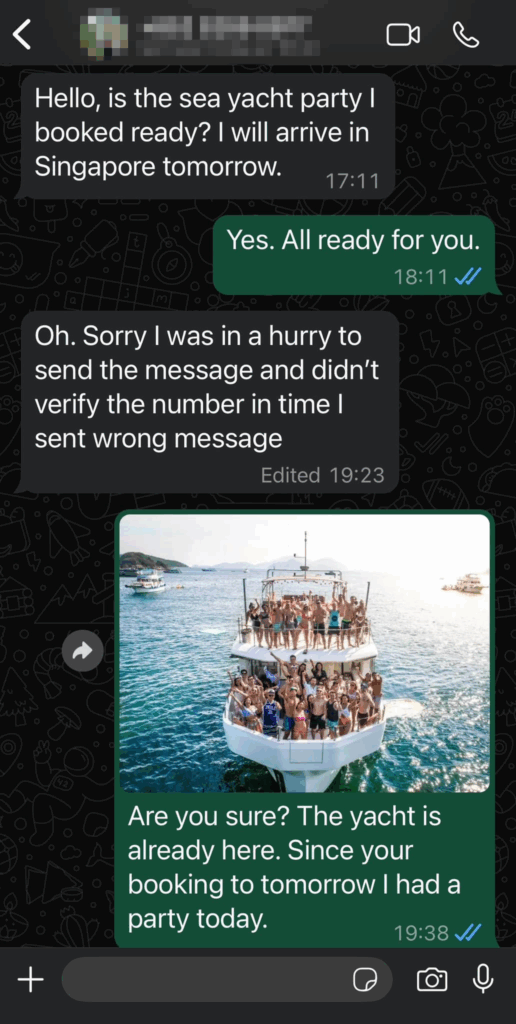
    “Hello, is the sea yacht party I booked ready? I will arrive in Singapore tomorrow.”

    I couldn’t resist. I replied, “Yes. All ready for you.” And when they backpedalled, I doubled down with a picture of a yacht packed with people, saying, “Are you sure? The yacht is already here. Since your booking to (sic) tomorrow I had a party today.”

    They stopped replying. I posted it on Facebook, and it got laughs. Cheeky win, right?

    Well… not quite.


    Why It Feels Good

    When you turn the tables on a scammer, it feels satisfying. You’re not the victim — you’re the prankster. Instead of being manipulated, you’re the one making them uncomfortable. Sharing it online adds another layer: your friends laugh, you get likes, the scammer looks ridiculous.


    The Hidden Risks

    But here’s the thing: engaging with scammers isn’t risk-free.

    • You confirm your number is active. Scammers trade lists of “live” numbers. By replying, you’ve just raised your value on the black market.
    • They adapt. If the yacht party script fails, another scammer might try a romance angle, an investment pitch, or even impersonating a delivery company.
    • They collect data. Even banter reveals something — your writing style, your humour, your timezone. That helps them sharpen their playbooks.
    • They can pivot emotionally. Remember the BBC pig-butchering video? When the reporter exposed the scammer, she suddenly claimed she was a captive, threatened with rape unless money was sent. Sometimes scammers will flip from funny to guilt-trip in a heartbeat.

    What You Should Do

    The safest way to deal with these “wrong number” or “accidental” texts:

    • Don’t engage. Block and report.
    • If you want laughs, screenshot (removing numbers/personal info) and share it after cutting them off.
    • Educate others. A funny reply can raise awareness, but it shouldn’t encourage people to start conversations with scammers.

    Closing Thought

    Behind that wrong-number text is a professional operation — scripts, psychological tactics, and sometimes even trafficked workers trapped in scam compounds. Remember: in pig-butchering scams, you’re the one they want to fatten up. Don’t give them a chance to sharpen their knives.”

    ⚠️ If you’re new to the term “pig butchering” and wondering what these scams look like at scale — scripts, fake girlfriends, even human trafficking — start here:
    👉 What Pig Butchering Scams Really Look Like (and Why You Should Care)

    What Pig Butchering Scams Really Look Like (and Why You Should Care)

    Imagine a stranger sliding into your WhatsApp: “Hi David, long time no see!”

    You reply, “Wrong number.”

    They smile digitally, strike up a chat. Before you know it, you’re sharing little details about your life with someone who seems charming, patient, and maybe even interested in you.

    That’s the start of a scam so sophisticated it has its own industry nickname: pig butchering—from the Chinese phrase 杀猪盘, literally “pig-killing plate.”


    Tailored Just for You

    These aren’t random stabs in the dark. Scammers have scripts and psychological playbooks that feel eerily like customer service training manuals. Every message is tuned to you—your career, your hopes, even your loneliness. They’ll spend weeks or months fattening you up with fake friendship or romance before sliding in the “investment opportunity.”

    It goes further: scammers even employ models—real women on payroll—to dress up, jump on video calls, and project a lifestyle of luxury. Think expensive watches, cocktails in rooftop bars, and “proof” of crypto wealth. The illusion? That your glamorous new girlfriend or boyfriend not only adores you, but wants to make you rich too.


    The Scale Will Shock You

    This isn’t a Netflix conman working solo out of a hotel room. This is industrialised crime.

    • In Dubai, police busted a pig-butchering ring with over 2,000 staff.
    • In Cambodia and Myanmar, scam centres sprawl like office parks—complete with armed guards, CCTV, and fences to keep the workers in, not out.
    • Many workers were lured in with fake job ads, had their passports confiscated, and found themselves trafficked into scam “factories.”

    This is cybercrime at scale, with the infrastructure of a corporate call centre—but powered by exploitation and fear.


    The Human Twist

    One of the best illustrations is in a BBC video. A reporter goes undercover, posing as a victim. When he finally calls out the scammer, she flips the script:

    “I’m being held captive. If you don’t send money, they will rape me.”

    Is it true? Maybe. Maybe not. That’s the chilling part. Victim or scammer? Sometimes they’re both.

    Meanwhile, YouTuber Jim Browning shows the other side: the dashboards, the fake profits, the inside of these operations. Together, they paint a picture of how this industry works—polished, manipulative, and deeply cruel.


    Why You Should Care

    • Victims lose billions globally.
    • They often stay silent, ashamed they “fell for it.”
    • It could happen to anyone: retirees, professionals, even people who think they’re too savvy to be conned.

    This isn’t about being gullible. It’s about being human.


    What You Can Do

    • Don’t engage with “wrong number” messages.
    • Be wary of online friendships that pivot to investment talk.
    • If something feels too consistent, too polished—trust your gut.
    • And if you’re caught? Report it. Shame belongs to the criminals, not the victims.

    Closing Thought

    These scams fatten you up with attention and affection. Then, when you trust them most, they bleed you dry. That’s why they call it pig butchering.

    Don’t be the next one led to slaughter.


    Want to See It for Yourself?

    💡 Also: want to see what happens when you actually reply to one of these “wrong number” texts? I tried it once. Here’s why trolling scammers feels good — but carries hidden risks:
    👉 Why Bantering with Scammers is Risky

    Building Digital Trust in a Scamdemic World

    (Insights from the Global Anti-Scam Summit Asia 2025)

    At the Global Anti-Scam Summit Asia 2025 (GASS Asia) in Singapore, one phrase stood out: “scamdemic.” It captures how scams have spread like a virus — infecting trust in our digital economy, our platforms, and even our personal relationships.

    Scams aren’t just about money lost. They erode confidence in the systems we rely on every day. If people stop trusting digital payments, e-commerce, or even a message from a friend, the cost goes far beyond the dollars.


    A Car Safety Metaphor

    One reflection I brought home from the summit is that scam prevention works like car safety. To stay safe on the road, you don’t rely on just one thing:

    • Safe driving = public education and awareness.
    • Mirrors and sensors = detection and early warnings.
    • Airbags and survivability engineering = protection when things go wrong.

    It’s the same with scams. We need multiple layers of defence, not a single silver bullet.


    Collaboration in Action

    For too long, telcos, banks, and platforms pointed fingers at one another. At GASS Asia, there was encouraging progress toward collaboration:

    • GASA’s Global Signal Exchange allows intelligence to be shared across borders.
    • Industry players are building APIs to block scams in real time, though they must balance fraud prevention with user experience.
    • In Singapore, we’ve seen practical steps like ScamShield, the 1799 hotline, and upstream blocking of scam calls and websites.

    These measures show that collective action is possible. But they also highlight a simple truth: technology alone will never be enough.


    Trust Begins at Home

    One repeated finding was that people trust family and friends more than any other source. That makes sense — but it’s also why scammers work so hard to infiltrate those circles, whether through impersonation, hijacked accounts, or social engineering.

    This is where awareness becomes personal. Talking openly about scams, sharing examples, and teaching red flags makes a real difference.


    Closing Thought

    Scams thrive when trust is misplaced — when people put confidence in the wrong voices, platforms, or promises. To build digital trust in this “scamdemic” world, governments and industries need to innovate; and we need to talk openly with family and friends.

    Because in the end, digital trust isn’t just engineered by apps or laws — it’s built through conversations, and reinforced every time one person helps another stay safe.


    Also in This Series

    This article is part of our reflections from the Global Anti-Scam Summit Asia 2025 (GASS Asia). You can read the full series here:

    Together, these articles explore how scams are evolving, how they affect all of us, and what we can do to fight back.


    👉 If you found this useful, share it with your family and friends. The more people we reach, the harder it becomes for scammers to succeed.

    Who Gets Scammed? It’s Not Just the Elderly

    (Insights from the Global Anti-Scam Summit Asia 2025 (GASS Asia))

    At the Global Anti-Scam Summit Asia 2025 (GASS Asia), one message was repeated often: scams don’t discriminate. The stereotype that only elderly people fall victim no longer holds true.


    Scams Take Many Forms

    Speakers at the summit grouped scams into eight main categories: dating and romance, e-commerce, impersonation, phishing, investment, prize and lottery, extortion, and jobs. Each type maps neatly to different vulnerabilities across age groups. No one is immune.


    Younger Victims

    Youths are falling prey to “deals” that look too good to resist — concert tickets, delivery promotions, even buckets of fried chicken. Task scams also target younger audiences with gamified rewards that hook quickly and escalate into financial loss.

    Love and connection play a role too. Online friendships and relationships can be manipulated into trust — and eventually, into money.


    Adults in the Middle

    Working-age adults are the main target for higher-value scams such as:

    • Fake job offers that require upfront “processing fees.”
    • Investment opportunities promising guaranteed returns.
    • “Pig butchering” schemes, where long-term emotional manipulation leads to fake trading platforms.

    The losses can be devastating, both financially and psychologically.


    Elderly Victims

    Older victims still represent a major share of scam cases, often losing larger sums because of their financial security and trust in authority. Government impersonation scams remain especially effective against this group.

    But the summit also highlighted something deeper: when the elderly are scammed, the impact often extends beyond money — creating shame, embarrassment, and reluctance to seek help.


    The Common Thread

    Different age groups may be targeted in different ways, but the psychology is the same: scammers adapt to vulnerabilities. Whether it’s greed, loneliness, urgency, or trust, there’s always a lever to pull.


    Closing Thought

    Scams aren’t a problem “for someone else.” They’re a risk for everyone. Talking openly about them helps break the stigma, makes it easier for victims to come forward, and strengthens the whole community against what some at GASS Asia 2025 called a global “scamdemic.”


    Also in This Series

    This article is part of our reflections from the Global Anti-Scam Summit Asia 2025 (GASS Asia). You can read the full series here:

    Together, these articles explore how scams are evolving, how they affect all of us, and what we can do to fight back.


    👉 If you found this useful, share it with your family and friends. Awareness is the first line of defence.

    Scams in the Age of AI — Friend and Foe

    (Insights from the Global Anti-Scam Summit Asia 2025)

    At the Global Anti-Scam Summit Asia 2025 (GASS Asia), one theme kept surfacing: artificial intelligence has transformed scams.

    The old stereotype of a scam email riddled with spelling mistakes and poor grammar? That excuse is gone. Today, scammers can generate flawless, persuasive messages in seconds — and scale their psychological tricks across thousands of people at once.


    AI as a Scammer’s Tool

    • Polished phishing: With generative AI, scam emails and texts look professional and believable. No obvious errors to tip you off.
    • WormGPT: An AI model stripped of ethical safeguards, designed to create malicious code and scam scripts.
    • OnlyFake: A platform churning out fake IDs, passports, and bank statements that can pass casual checks.
    • Language overlays: Apps running on top of trusted platforms like WhatsApp make scams seamless across borders, automatically translating in real time.

    Scammers aren’t experimenting anymore. They’re industrialising.


    AI as a Defender’s Tool

    Fortunately, the same technology works both ways. At GASS Asia, industry experts showed how AI is being used to:

    • Detect unusual transaction patterns before they escalate.
    • Flag suspicious accounts or behaviour on platforms.
    • Even “chat back” with scammers using bots — tying them up in long conversations, so they spend less time targeting real people.

    AI isn’t just an attack surface; it can be part of the shield.


    What It Means for You

    For everyday users, the lesson is simple: you can’t rely on “spotting the typo” anymore. The psychological hooks — greed, urgency, love, fear — are still there, but the packaging looks more convincing than ever.

    This makes awareness and verification even more important. When something looks too good to be true, slow down. Verify through official channels, not the links or numbers handed to you in a message.


    Closing Thought

    AI is neither good nor bad on its own. It’s a tool — and both scammers and defenders are racing to use it faster and better.

    In this age of AI-driven scams, the most important skill isn’t spotting bad grammar. It’s learning to pause, question, and double-check.


    Also in This Series

    This article is part of our reflections from the Global Anti-Scam Summit Asia 2025 (GASS Asia). You can read the full series here:

    Together, these articles explore how scams are evolving, how they affect all of us, and what we can do to fight back.


    👉 If you found this useful, share it with your family and friends. Awareness spreads faster when we talk about it — and that’s how we stay one step ahead.

    Reflections from the Global Anti-Scam Summit Asia 2025

    Glad to be able attend the Global Anti-Scam Summit Asia 2025 in Singapore. Across two days, one theme stood out clearly: scams are no longer niche or amateur — they are professional, adaptive, and global. Here are some highlights and reflections.

    The Scale of the Problem

    • In Singapore, digital crime now outpaces physical crime two to one.
    • On average, each person in Singapore loses US$1,000 to scams.
    • It’s no longer just the elderly — younger people are also being caught out, often by “good deals” (concert tickets, food deliveries, task scams).

    The Psychology of Scams

    • Scams are not about how intelligent you are; they are designed for you. 94% of adults try to verify offers, yet billions are still lost.
    • Greed, trust, loneliness, and love are powerful levers — and scammers know how to pull them.
    • The impact goes beyond money: shame, withdrawal, and even self-harm are real consequences.

    Technology: Weapon and Shield

    • AI is changing the game. Gone are the days of scam emails full of grammatical mistakes. AI now generates polished messages and can deploy psychological tactics at scale.
    • On the flip side, AI is being used by defenders to detect unusual activity and even “chat” with scammers — keeping them occupied and away from real victims.
    • Scammers also layer apps on legitimate platforms. One example: a translation tool running on top of WhatsApp, making scams seamless across languages.
    • Tools like WormGPT and OnlyFake (fake IDs and documents) show how innovation cuts both ways.

    Collaboration and Cat-and-Mouse

    • Speakers broke down scams into a lifecycle: preparation (profiling, phishing kits, AI tools), deception (initiating contact and social engineering), and monetisation (laundering illicit funds). It’s a reminder that scams are structured enterprises, not random one-offs.
    • For years, telcos, banks, and platforms pointed fingers. Now, there’s a push toward collaboration — data sharing, APIs, and initiatives like GASA’s Global Signal Exchange.
    • Singapore’s own approach includes upstream blocking of scam calls/sites, tighter laws, public reporting, and education via ScamShield and the 1799 hotline. (Ironically, scammers are already spoofing calls claiming to be from the scam centre.)
    • It’s clear: there is no 100% tech solution. Trust, vigilance, and human awareness remain essential.

    Human Cost and Unseen Victims

    • Behind the headlines are people trafficked into scam compounds, forced to work under duress. This hidden second layer of victims is often forgotten.
    • One exposé revealed a compound in the UAE with 2,000 workers running pig-butchering scams. The sophistication was chilling: real girlfriends on-site, curated social media profiles, even video calls to build trust — all leading victims toward fake investment platforms.
    • Groups like the Luffy crime ring show how organised, ruthless, and adaptable these networks have become.

    Where Do We Go From Here?

    The summit closed with more questions than answers:

    • How do we balance fraud prevention with user experience?
    • How do we build trust as effectively as scammers do?
    • Who draws the line of responsibility — governments, industry, or us as individuals?

    Here at Security Common Sense, we believe awareness starts at home. That’s why we’ve been working on this site for a few years — to help friends and family cut through jargon, spot red flags, and talk about scams openly. If you’ve stumbled across us and find us interesting, share it with your friends and family too.


    Also in This Series

    This article is part of our reflections from the Global Anti-Scam Summit Asia 2025 (GASS Asia). You can read the full series here:

    Together, these articles explore how scams are evolving, how they affect all of us, and what we can do to fight back.

    Scroll to top